
Welcome to our homestead, home of our RAW, unheated, untreated, 100% natural honey from our chemical-free and organic practice beekeeping.

Bees Know Best
Honeybees (Apis mellifera and related species) have been making honey for approximately 20 to 30 million years. Humans have been collecting honey from wild hives for 9000 years, and “beekeeping” for more than 4000 years!
What we do is traditional organic beekeeping. It is a buzz-worthy art that keeps our honey 100% natural: untreated wooden hives, no nasty chemicals, and letting bees do what they do best.
While most bees stay within a mile of the hive, they can travel up to 5 miles when foraging. We have nurtured our 10 acres to be ripe with native wildflowers, grasses, clover, fruit trees, vegetable plants, and berry bushes to support our bees. We want our bees sipping nectar from pesticide-free native plants, and bringing that pollen home to create the most delectable honey so we can share it with you.
It’s all about happy, healthy bees pumping out pure, top-notch honey and tough colonies that have never been chemically treated for mites and other pests that can kill a whole hive.
Learn Organic Beekeeping with us
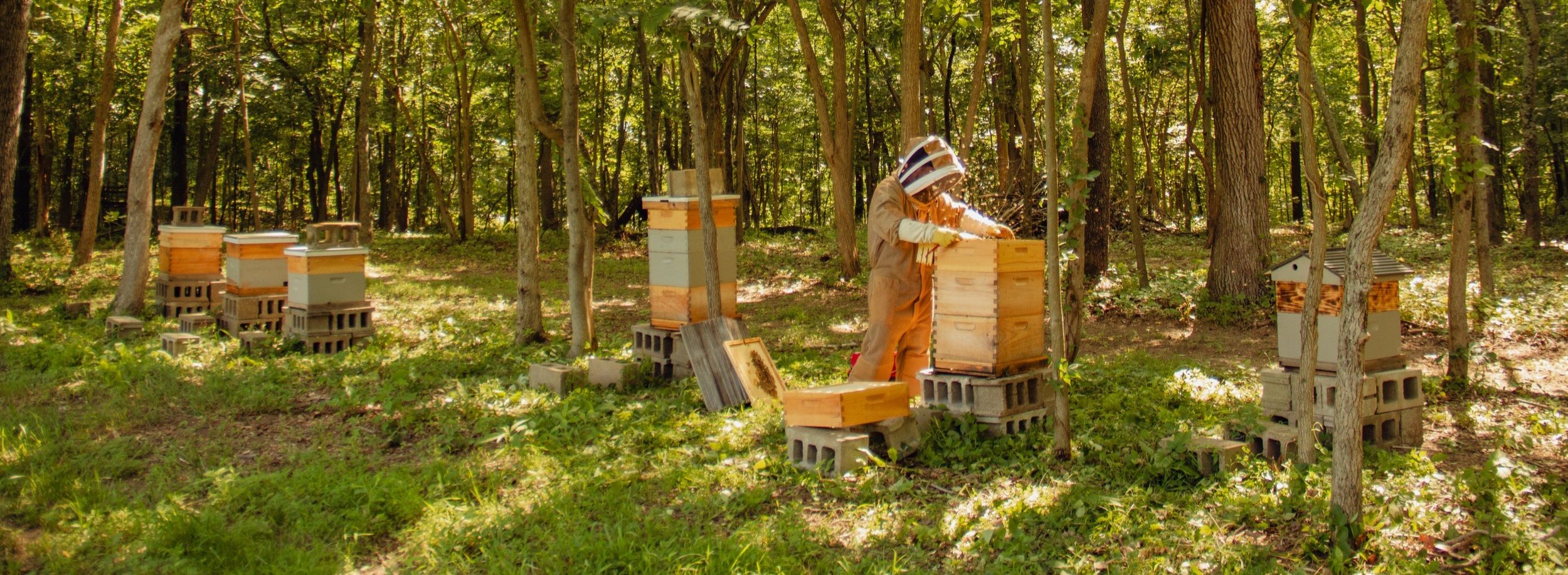
Learn to keep bees the right way — from someone who does it every day. Lazy Acres Apiary's 3-month Beginner Beekeeping Mentorship is a hands-on, in-person program designed for complete beginners who want to learn organic, chemical-free beekeeping on a working farm in Norwich, Ohio.
Every two weeks you'll join us at the hive for a private, guided session with Michael — six sessions total over three months, each one building on the last. Your own starter hive lives right here on the farm between visits, cared for daily as part of our working apiary. You get all the learning, the hands-on experience, and the joy of having your own colony — without the risk and uncertainty of going it alone from day one.
Mentorships begin in April or May, timed to the start of bee season when our hives are ready to split naturally. Your starter colony will be populated with bees from our own apiary — several generations into a mite-resistant genetics and breeding program. That's not something you can buy off a pallet. Most beginners start with package bees from unknown stock; you're starting with bees that have already proven themselves in this environment.
What you'll learn:
How to safely open and inspect a hive
Identifying a healthy queen, worker brood, and drone brood
Spotting signs of a thriving colony vs. early warning signs
How to read bee behavior and understand what the colony is telling you
Natural, organic pest management — including Varroa mite monitoring and counting
Recognizing swarming behavior and understanding why it happens
Seasonal rhythms of a colony and how to support them naturally
Equipment basics and how everything works together
How to set up your own hives at home when you're ready
Month by month: Month One you'll learn to open and close the hive safely, identify the three castes, spot eggs and larvae, get comfortable with the smoker, and start developing your eye for what a healthy colony looks like. Month Two you'll conduct a full inspection independently, learn the Varroa mite lifecycle, perform your first mite count, and understand when and why to expand the hive. Month Three you'll lead your own full inspection with Michael observing, interpret a complete hive health assessment, and finish with a clear picture of what comes next.
What's included:
6 private, in-person hive sessions every two weeks, guided by seasoned beekeeper Michael
Your own starter hive on the farm, populated with our locally bred, mite-resistant bees and folded into our regular apiary care between visits
Extra sessions and hands-on guidance if any issues arise — so problems get caught and addressed early
Your own copy of the Lazy Acres Beginner's Organic Beekeeping Workbook — custom written for this program, covering everything from bee biology and hive anatomy to organic pest management and seasonal care. A formal course and a hands-on experience rolled into one.
Ongoing support between sessions — Michael is always reachable with questions
Organic, chemical-free approach from start to finish
Stay with us and the rewards keep growing: Stick with us through fall and you'll have the opportunity to keep 50% of the honey your hive produces — raw, local, and organic honey you helped make. Stay on through the following spring, and if your hive is strong enough to split, those bees are yours to take home. With a full year of beekeeping under your belt, you're more than ready to start your own hive at home if you so choose — with less apprehension, more confidence, and a better chance of success than starting from scratch.
Investment: $375 for the full 3-month program Location: Norwich, Ohio · BeesKnowBest.com

Did you know these fun facts about honeybees?
-
Honeybees have impressive memory and can distinguish human faces, a skill known as "configural processing." Studies show they can be trained to associate faces with rewards, like sugar water, and remember them for days—pretty smart for a tiny brain!
-
Bees perform a "waggle dance" to tell their hive mates where to find food. The angle of the dance indicates the direction relative to the sun, the duration shows distance, and the enthusiasm reflects the quality of the nectar or pollen source. It’s like a GPS in dance form!
-
In addition to their two large compound eyes, bees have three small simple eyes (ocelli) on top of their heads. These detect light intensity and help with navigation, especially on cloudy days or in low-light conditions.
-
Bees sometimes sip nectar that has fermented into alcohol, making them tipsy. Drunken bees wobble, bump into things, and may even get banned from the hive by sober guard bees until they sober up!
-
Honeybees exhibit circadian rhythms, allowing them to time their foraging trips to when flowers produce the most nectar. They can even adjust their internal clocks to follow shifting sunrise times or artificial light schedules in experiments.
-
Research shows honeybees can understand basic arithmetic, like addition and subtraction, using colored shapes. They’ve even grasped the concept of zero, a cognitive feat rare in the animal kingdom!
-
Honeybees regulate hive temperature like pros. In hot weather, they fan their wings to cool the hive, and some even bring water droplets to evaporate for extra cooling. In cold weather, they huddle and vibrate their muscles to generate heat, keeping the hive at a cozy 92–95°F (33–35°C).
-
Honeybees produce honey with natural preservatives like low water content and high acidity, making it an inhospitable environment for bacteria and microorganisms. Archeologists have found 3,000-year-old honey in Egyptian tombs that’s still perfectly edible!
Egyptians placed honey in pharaohs' tombs as an offering for the afterlife, believing its eternal preservation symbolized immortality and divine sustenance. Honey's antibacterial properties also helped preserve food and possibly the body, aligning with their mummification practices.
-
Honeybees use optic flow—the rate at which objects pass by their vision—to gauge how far they’ve flown. This helps them accurately communicate distances in their waggle dance, even if they take a detour or face windy conditions.
-
Honeybees have an incredible sense of smell, detecting pheromones and floral scents through thousands of sensory receptors on their antennae. They can even sniff out explosives in some experimental training programs, rivaling sniffer dogs
-
While honeybees see ultraviolet light (revealing patterns on flowers invisible to humans), they can’t distinguish red hues well. They’re drawn to blue, purple, yellow, and white flowers, which often have UV markings that act like neon signs saying, “Nectar here!”

OHIO! Find us locally
Find us at the From Scratch Co-Op
433 Wheeling Avenue, Cambridge, Ohio
Every Saturday from 8am-12pm June - September
https://www.fromscratchcoop.com
